
The European Accessibility Act and webshops: who must comply, fines in Croatia, Austria and Germany, and a checklist
The European Accessibility Act has applied since 28 June 2025. We checked the Croatian, Austrian and German rules: who is covered, who is exempt, how high the fines are and what a webshop needs.
The short answer
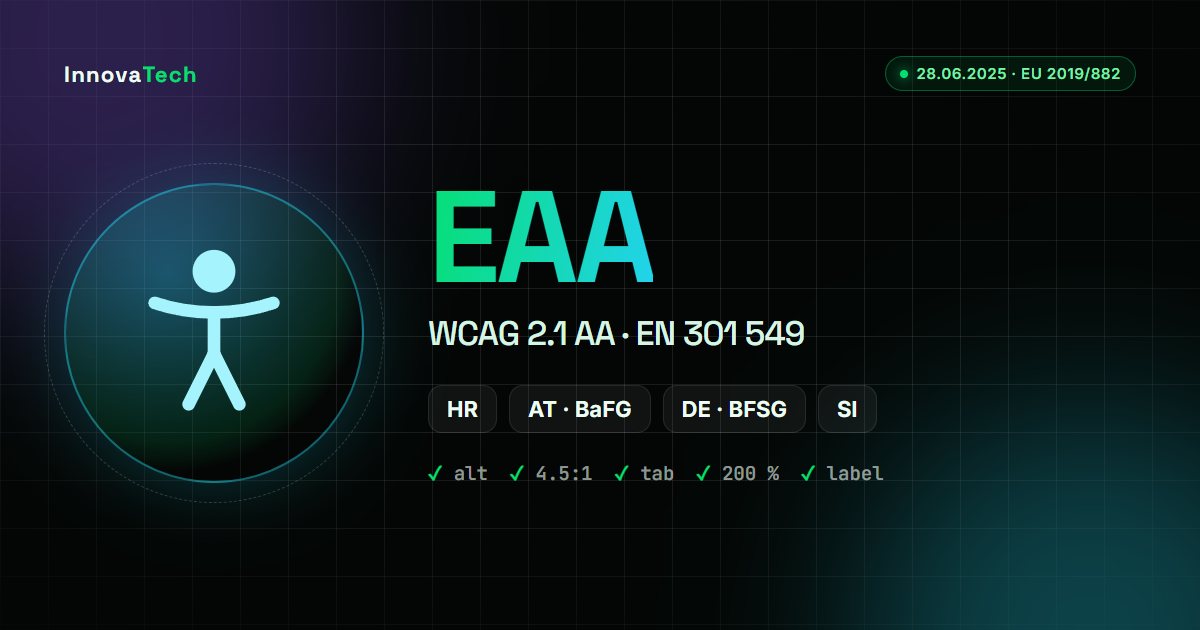
Since 28 June 2025 the European Accessibility Act (Directive (EU) 2019/882) has applied across the whole EU. Croatia transposed it in the Act on Accessibility Requirements for Products and Services (Official Gazette 89/25), Germany in the BFSG and Austria in the BaFG. It applies to everyone selling to consumers through a website or app – webshops, online ordering and paid bookings – except micro-enterprises (fewer than 10 employees and up to €2 million turnover or balance sheet). In Croatia, fines for companies range from €6,630 to €132,720.
Who has to comply?
The law covers e-commerce services: any service provided at a distance through a website or mobile app through which a consumer concludes a contract. In practice that means webshops, online ordering, ticket sales and bookings with payment. Besides e-commerce it also covers consumer banking, electronic communications, e-books and parts of passenger transport.
Purely informational websites where no contract is concluded (for example a company site with a contact form) are generally not covered, and neither are sales only to other businesses.
The micro-enterprise exemption – and why it doesn't mean “not my problem”
Under Article 4(2) of the Croatian act, the law does not apply to micro-enterprises providing services: those with fewer than 10 employees and annual turnover or a balance sheet of up to €2 million. Many small webshops are therefore formally exempt. Still, consider this:
- Once you cross the threshold, the obligation applies – and retrofitting a large shop costs more than building it accessibly from the start.
- If you sell to Germany and Austria, your competitors there are making their shops accessible and customers expect it.
- According to EU figures, around 90 million people in the EU – roughly one in four adults – have some form of disability. Add older customers and everyone shopping one-handed on a phone.
- An accessible site uses clean, semantic HTML – which is also easier for search engines and AI tools to read.
Fines and enforcement: Croatia, Austria, Germany
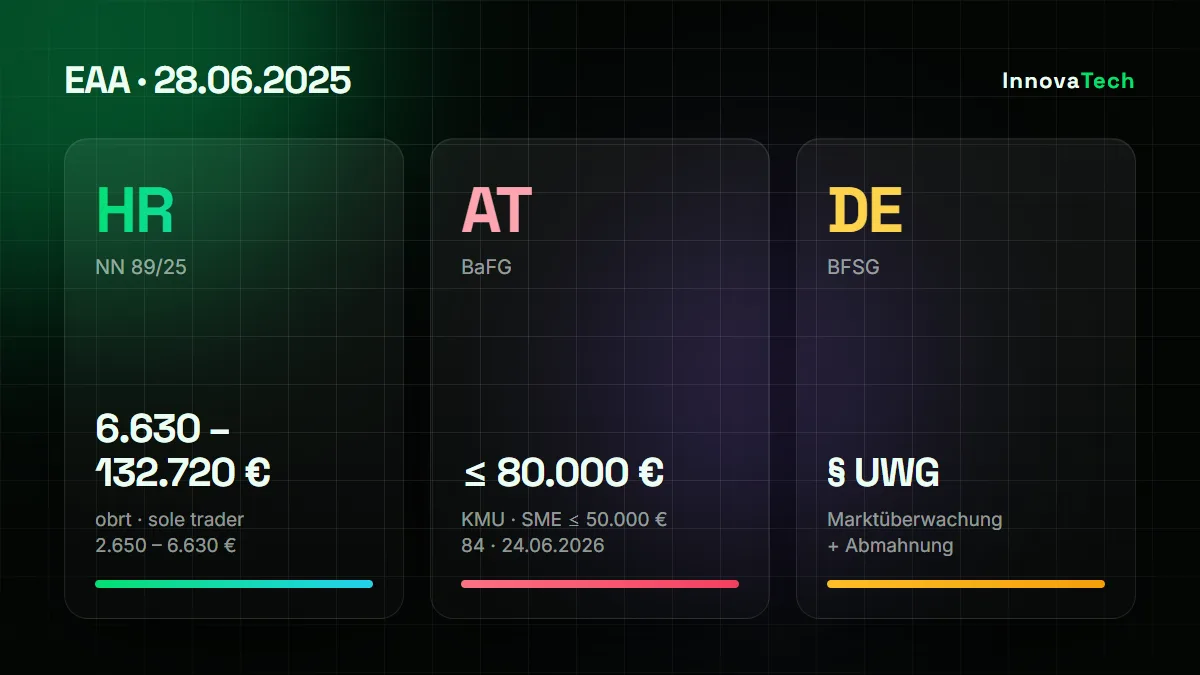
- Croatia: enforced by market inspectors of the State Inspectorate. Companies: €6,630 – €132,720; responsible person within a company: €2,650 – €6,630; sole traders and other self-employed persons: €2,650 – €6,630.
- Austria (BaFG): enforced by the Sozialministeriumservice. Up to €80,000 for the most serious violations, up to €50,000 for SMEs. By 24 June 2026, 84 cases had been opened.
- Germany (BFSG): enforced by the market surveillance authorities of the federal states, and violations can also be treated as unfair commercial practice – which opens the door to warning letters from competitors (Abmahnung).
Besides a fine, the authority can order a non-compliant service to be withdrawn from the market.
A checklist for your webshop
The practical benchmark is the European standard EN 301 549, i.e. WCAG 2.1 level AA. For a webshop that means:
- Every product image has meaningful alternative text.
- Text contrast is at least 4.5:1 (3:1 for large text).
- The whole purchase – from category to payment – can be completed with a keyboard only.
- Focus is always clearly visible.
- Every form field has a label, and errors are described in words, not just in red.
- The site works at 200% zoom and on mobile without losing content.
- Headings are structured correctly (H1, H2…) and the page language is set.
- Videos have captions and automatic sliders can be paused.
- The cookie banner and pop-ups can be closed with the keyboard and are read by screen readers.
- Your terms or a dedicated page explain how the service meets the accessibility requirements.
Why an “accessibility widget” is not the answer
Many retailers install a ready-made plugin with an accessibility icon and think the job is done. In one proceeding by the Austrian authority, auditors tested a site with the plugin switched off and found broken keyboard navigation, unlabelled forms and error messages that screen readers didn't announce. With the plugin switched on, new problems appeared: worse contrast and overlapping text when zoomed. The company received an audit report and 14 days to respond.
Accessibility is fixed in the code and design, not by a plugin loaded on top of a finished site.
How we approach it
We build new webshops and websites in Nuxt with semantic HTML, checked contrast, keyboard navigation and labelled forms. For existing shops we can review the key purchase steps and fix what blocks customers. We work with clients across the EU, including Germany, Austria and Slovenia.
- Webshop – from €400
- Webshop with card payments – €450
- Adapting an existing site – Nuxt development at €33/h
♿ Is your webshop accessible?
Send us your shop's address – we'll tell you what needs fixing and what it would cost, with no obligation.
Request a free estimate →This article is for information only and is not legal advice. To assess your specific obligations, check the current text of the law in your country or consult a lawyer.
Sources
- Narodne novine 89/2025: Croatian Accessibility Requirements Act
- Zakon.hr: consolidated text
- EUR-Lex: Directive (EU) 2019/882
- Council of the EU: Disability in the EU – facts and figures
- Eye-Able: enforcement in Austria
- Deque: Early signs of EAA enforcement across Europe